Wednesday, February 15, 2006

Glass Handgrenade with the Pin Pulled


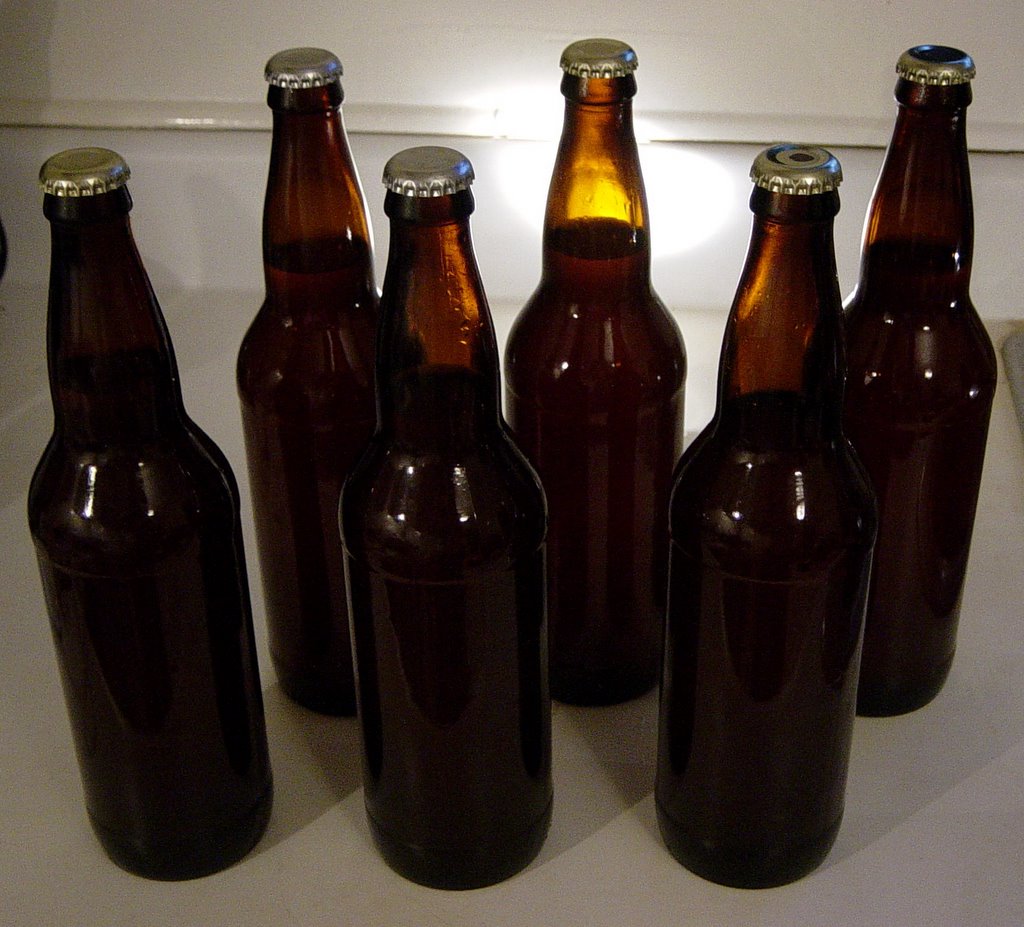
Three bottles of cider exploded in the basement sometime in the last two weeks. Didn't hear 'em, but had a bad feeling about 'em.

The Oak Glen Cider was pretty sweet, and we goosed it as it went down to assure a fizzy end result. The last two bottles we opened ever so carefully shot 4 feet in the air, and all but about 250 ml was lost!

It was good stuff though; and oh what a wallop!

Still, especially with the recent spate of warm weather, I should have been expecting the problem and opened and re-bottled all of them.

When I went down to the basement to put away some empties, I noticed we only had one bottle standing.

Yikes!

Since that one bottle was essentially a glass grenade with the pin pulled, I lifted the remaining bottle out of the shards and carried it, ever so slowly, in gloved hands, wearing eye protection, out into the backyard. I set it carefully on the table, and gingerly popped the cap. As I am getting better at catching air borne cider, I got nearly 300 ml of the 600 or so in the bottle.

It made a lovely meter-tall spout of out of the bottle, though.

Meanwhile, the TJ cider is cloudy, skunky, and low on alcohol too; nice fizz though. So we will give all that cider another six weeks or more before we open another tester.

'Course, this happened last time, now that I think of it. The bottling was so undrinkable at the early test that we got discouraged and let it age another two or three months -- at which point it had clarified and was quiet yummy. Stand by on this one!

Sunday, February 12, 2006

Moonlight

The full moon came up tonight through the branches of the oak tree down the street, with just a swirl of white clouds brightly lit by the lunar glow. The night is cool, though the day was warm, and using the laptop on the WiFi under our own Moontree is a real delight.

We have spent many long days cleaning up for summer; chopping down the overgrown vines and weeds behind the garage, mowing, trimming, and pruning everything; losing a couple of plants we've been meaning to ditch for some time.

The winter salad garden has started to grow, finally, but something is eating the shoots off to the dirt pretty darn quickly, so I have little hope. Weirdly, some of the heirloom squash we planted and at least a few of the watermelon seeds have germinated -- although none of them came up at all over the spring and summer after we planted them last year! Go figure.

Broccoli is doing well, and I have had more than a few meals of organic home grown broccoli, especially yummy on the organic linguine noodles from Trader Joe's sprinkled with the sheep's milk TJ brand "powdered cheese" in a green can.

This being my first crop of broccoli, I have learned that the heads come out a little smaller under less than ideal conditions (like my random watering) and how to tell when a stem is ready to cut, and why it is poor eating when cut too late. Next batch will do better. I will also discover an organic antidote for the lovely cabbage worms/moths.

Oh, the kids love the little white "butterfly" that visits us. Any time they see one they pretend that it is the same one and say hello to "Cabbage." Yes, they named a moth Cabbage. (I think Spencer may have started that one; Kathryn likes to name the worms in the worm bin. )

But when I find as many little cabbage worms doing battle for my broccoli as there was broccoli on the last batch, a solution must be found!

[Update: Soaking the heads in salt water dropped three broccoli green 'pillars off of my dinner; alas the steam of cooking killed two more I missed! At least steamed caterpillar is gray so it is hard to miss in the pot. Makes me wonder though what I did miss on the broccoli I had raw on my salad yesterday!]

The winter garlic and onions never made it, although that could be due to my habit of pulling green garlic to use the chopped stems and subtle fresh baby garlic in salads and the like. (Grin). Similar fate for the shallots.

The red potatoes have been going great guns. One plant began to die off, and so I pulled it, and have five "shooter" marble sized new potatoes fresh from the ground. Meant to have them for dinner yesterday, will tonight.

Mandarin Orange crop is in full; the family love to grab a "cold one" off the tree in the morning on the way to school and work. Weirdly, they are also good and kind of fun to eat picked hot in the full afternoon sun.

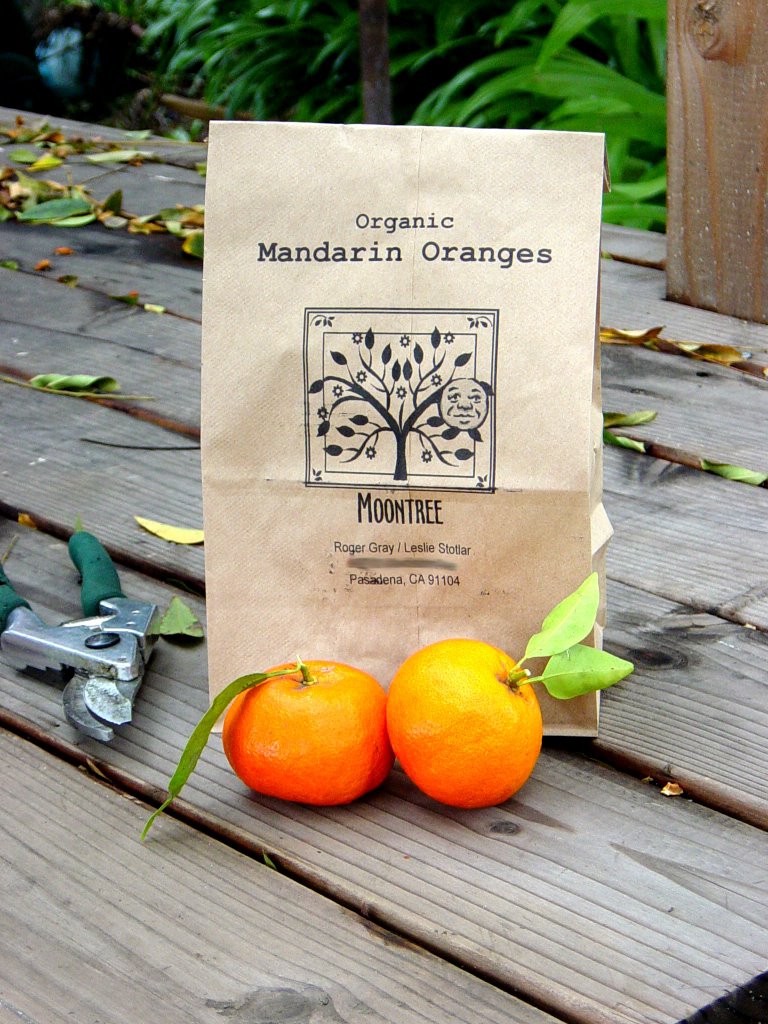
Recently, I found that I could print a label on brown paper bags, and so have been giving away little collections of "Moontree Organic Mandarin Oranges" and lemons too. Kinda fun.

Now I wrote "Organic" on the bag because they are; we follow the organic farming guidelines. Or rather we use fewer even "natural" chemical inputs than the guidelines allow, and under USDA rules, we could actually sell these with this label. (We "make" less than $5,000 from sales of organic produce, so may use the label if we comply. One can only use the "USDA Certified Organic" if one has been certified.)

Wonder how the City of Pasadena would feel about the kids setting up an Organic Fruit Stand each February?

Tuesday, January 24, 2006

Blustery Day, Blustery Night: Busy Month

Whew! The big wind blew; branches broke, trees (elsewhere) toppled! The yard is a mess. The moontree stayed put, but morning zazen is on hold until February for clean up. This was to be a long January-was-crazy post from a coffee house somewhere, juggling the baby and the laptop. Instead it is a placeholder, a promise, to me and a few readers, to get back to work here just as soon as we recover from the Big Blow of '06.

Saturday, December 31, 2005

Happy New Year!

Auld Lang Syne

Should auld acquaintance be forgot,
And never brought to mind?
Should auld acquaintance be forgot,
And days of auld lang syne?
And days of auld lang syne, my dear,
And days of auld lang syne.
Should auld acquaintance be forgot,
And days of auld lang syne?


We twa hae run aboot the braes
And pu'd the gowans fine.
We've wandered mony a weary foot,
Sin' auld lang syne.
Sin' auld lang syne, my dear,
Sin' auld lang syne,
We've wandered mony a weary foot,
Sin' auld ang syne.

We twa hae sported i' the burn,
From morning sun till dine,
But seas between us braid hae roared
Sin' auld lang syne.
Sin' auld lang syne, my dear,
Sin' auld lang syne.
But seas between us braid hae roared
Sin' auld lang syne.

And ther's a hand, my trusty friend,
And gie's a hand o' thine;
We'll tak' a cup o' kindness yet,
For auld lang syne.
For auld lang syne, my dear,
For auld lang syne,
We'll tak' a cup o' kindness yet,
For auld lang syne.

Monday, December 26, 2005

Clean Coffee, Extreme

Today I drank a sustainably grown, organic, fair trade, sustainably ground and sanely brewed cup of gourmet coffee.

I think I may have saved an entire square meter of polar ice from premature melt all by myself.

A combination of comments on other blogs -- both by me and other bloggers -- lead to this simultaneously cool and revolting turn of events.

First, playing me-too to GreenLaGirl's Starbucks Challenge reawakened my awareness of Fair Trade certified coffee and the value in not turning to an exploitative commodity for my middle-class American daily coffee fix. Indeed, because of the zealousness with which I joined the challenge game, GLG and CityHippy rewarded me with a package of Monkey & Son fair trade certified, organic certified, whole bean coffee.

This was very cool, because I had exchanged emails with the Monkey and had meant to come try a sample, but never did. Of course, as good coffee should, this arrived as whole bean coffee, which left a new dilema -- how to render it brewable.

Next, since the cool prize arrived last week, just at the height of pre-solstice/Christmas madness, it sat a few days to be admired -- and pondered -- as I set about finding a way to grind it. (We grind ours at the store, usually, and use it in a few days.)

I considering digging out the electric "spice mill and coffee grinder" I'd had for years, but I could hear the echo of some forgotten coffee gourmet scoffing about "chopped coffee" versus truly "ground" coffee, and the distinct superiority of the latter. Since my "spice mill" was, clearly, a simple whirling blade in a container, I could not, as my first choice, lower myself to drink chopped coffee. My second choice, the use of the amusing "magic bullet" mini-blender received as a wedding gift was no better. Another classless bean chopper!

(As an aside, the Bullet makes a sublime, quick, smoothie out of frozen fruit, milk and honey. A smoothie is just viciously chopped fruit and ice and does not need to be ground.)

Then, of course, I had been blogging over on Easy Green about electric appliances and how some were excessively juice-eating when a non-electric alternative was usually available. There was another strike against both mill and bullet.

Then I remembered that I had a hand-cranked coffee grinder from my Stepmother's recent return to her native England, a heavy, hand cranked iron device, that slowly slid the beans down a giant screw until each bean was pressed between counter-rotating ribbed steal plates, to emerge as lovely, truly ground coffee on the bottom.

Now this was not one of those dorky decorative faux antique coffee mills. This was the real deal, a serious kitchen tool, with three bolt-holes to bolt it to the wall for heavy duty and daily use, or a removable clamp to temporarily screw it down to the table top.
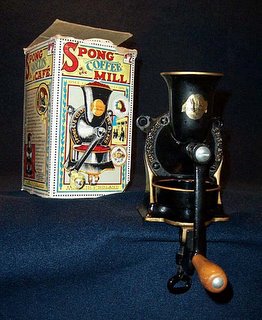
Click Here for the HistoryJust for fun, I went on the web to find a cool picture and discovered that these mills are coveted and ebayed like crazy -- in Australia and New Zealand (!) and the following additional history, according to the folks at www.coffeehouseinc.com:

"James Osborne Spong started a small family business in 1856 in London, England to make economic household utensils. His coffee grinders have changed design very little since the beginning as he found no improvements necessary."

Mine appears to be from modern production, due to having a red plastic hand grip not wood, but otherwise looks pretty well identical to the one shown here. There is a LOT of interesting coffee mill and coffee history at this collectors' site.

In any case, I clamped the ol' Spong Mill to the table, filled it with beans, and "gave the crank a whickity wank" as the song says.

Et viola, hand-ground, Fair Trade, Organic coffee.

Not only actually ground, but ground without all that coal-based electricity they sell us here in Pasadena. (And who wants coal-based electricity in their coffee, hmmm?)

The next amusing coincidence came about in that my In-Laws gave me my very own French press for Christmas. Mom-I.L. had been reading this space or the SBX, Fairtrade & Me blog about my adventures trying to get French pressed coffee. Now, all that time I was not looking for French Pressed coffee per se -- it seems too strong to me when the Starbucks crowed makes it -- rather I was looking for the right answer on their willingness to press Fair Trade coffee, without prompting.

Still, truth be told, I had wanted a French press for home, but could not justify it with a new-ish Mr. Coffee gleaming on the counter top.

Still, too, back at Easy Green, I had griped particularly that my plain Mr. Coffee draws 900 watts of power, sucking up some 1.8 kWh when left idling for the preset auto-warm designation. Now, once again I say, who wants coal-fired coffee?

I was also feeling a little guilty that ArdentEden gave me part credit for causing her to feel terrible guilt when she used her coffee maker, yet I had not yet given up my own electricity-sucking devil even as I had named it demon.

Unfortunately for us, most of our electricity falls from the sky, and is sustainably grabbed up by our solar cells. The rest, if there is any that the sun doesn't supply, comes from Green Power, which in this case is wind-generated power supplied by the city.

So sometimes I feel we can afford to be a little cavalier in our use of electricity, what with most falling, free, from the sun and the rest coming cleanly from the wind. But since we want to try to come in at 100% solar, net for the year by April 7, and we have added both forced-air heat and central air conditioning since the solar install, I'll take the potential 300 or so kWh a daily cup of coffee would cost and save it, thank you.

So, out comes the the cool new French press.

Of course, I still boiled the water on a gas stove -- I joked that I was going to boil the water by burning recycled paper grocery sacks, but nobody laughed. At first I thought it might have been that I was being ridiculous because the gas stove was perfectly workable; now I'm not sure that I didn't get a polite laugh because it was obvious that the green house gases and particulate matter generated by a grocery bag fire would be far worse than burning a little natural gas. Sigh. Like anything, fundamentalism just leads to absurdities.

But there it is, Ladies and Gentlemen: The Sustainable Cup of Coffee (more or less).

Fair Trade, Organic, Hand Ground, French Press brewed. With just a nibble of Trader Joe's Fair Trade, Organic extra dark chocolate on the side. Mmmmm mmmm. Good Monkey.

The coffee itself: Next Entry.

Wherein we wonder why all FT coffee we have tasted so far has similar bright overtones, but not the deep, rich mellowness of say the TJ house brand Organic . . . curiouser and curiouser!

Thursday, December 15, 2005

Lights & the Season

T he light is special this time of year.

Seems that, no matter where you are, the brief, bright winter light has an impact on people -- around the globe and down through the ages.

This winter has been dry and bright and cold for Southern California, but even without the gloom of rainclouds it gets dark pretty early.

I've been noticing the light a great deal this year. The track of the noontime sun changes from a 45 degree elevation across the southern sky, to a 90 degree overhead-noon in summer. This affects our comfort, and our electric bill, as the lower winter angle generates more power from our solar cells while the higher summer one is a longer trek, and hotter.

I am trying to grow some winter salads, too, but it has been cold enough at night, with a couple of soft freezes, that the salad patch is not doing so well. I blame the low light.

The broccoli and garlic and shallots, planted three feet from a heat-and-light reflecting southern wall, are doing well.

As a "farmer" and a user of solar energy, I am more keenly aware of the light than ever, although I have always been partial to indoor light less harsh than the average Edison-bulb.

Dimmer switches, candles and oil lamps usually cover my house; I lived in gleeful anticipation of power outages, just to have an excuse to fire up the candles and the oil lamps. What a beautiful, relaxed glow they provide for light.

Some mornings, when I am up before everyone, I need to see in the dinning room area but do not want to turn on the bright overhead light. Our 1903 house has the bedrooms directly connected to the dining area, so I risk waking the big kids, the wife and the baby. So I have been known to light an oil lamp -- just one, because more would be too bright(!) -- and pad around in the glow preparing for school or Saturday chores, or, with a certain deliberate irony, reading the newspaper online before it has washed up on our front porch.

We will note and celebrate the Winter Solstice this year, December 21 or so each winter season. Contrary to what some calendars might say, it is not the First Day of Winter, merely the moment when the sun reaches its shortest appearance in the daytime sky, shudders to a halt, and begins to lengthen, again, the time it spends warming my broccoli plants.

That's right. Everyday from the solstice on is a bit longer than the day before. Just like the Summer Solstice marks the longest day of the year in June, and two days later it is "Midsummer" of A Midsummer Night's Dream fame, the Winter Solstice marks the half-way point.

In ancient Celtic traditions, Midwinter marked a mythical battle between the Holly and the Oak, won each year by the Oak, the bringer of spring and the green.

We will note and celebrate the Winter Solstice this year, with a bonfire in the yard. The ancients marked the return of the sun with fire, some say calling the sun to return. (And what do you know, the sun always answered the call!) The cycles of the sun, more so than ever, seem important to our household -- notwithstanding that most of the rest of our modern culture is unaware of its importance.

Amusingly, the light-festivals of the ancient cultures can be seen all around us, and all cluster at this, the darkest time of year:

The Jewish "Festival of Lights," Chanukah, falls in winter months; Hindus celebrate Dipavali (Diwali and Depawali) in November, again "The Festival of Lights", Swedes celebrate St.Lucia Day on December 13, again, a festival of lights; Ramadan for Muslims falls in the winter space, as does the previously noted Bodhi Day, a day not of lights, but enlightenment and awakening. Kwanza, a modern invention, involves candles and the winter dark time. Modern Christians, and the secular Christmas-ians, celebrate with lights on houses and trees, even, in recent times, invoking the older phrase Festival of Lights frequently.

The light is special this time of year.

Thursday, December 08, 2005

Enlightenment

Today, December 8, is Bodhi day. This is the day traditionally marked by Buddhists as the day Shakyamuni, Prince Sidartha, gained enlightenment sitting under the pipala or fig tree. The teachings of the Buddha or "enlightened one" are well documented easily available on the web; in the end the teachings offer an end to human suffering through enlightenment -- clear awareness about the nature of things, the interconnectedness of all beings and things, and the cessation of suffering through release of greed and grasping.

The folks debating whether stores should announce "Merry Christmas" or "Happy Holidays" miss the point. They would do well to leave off the debate and focus on becoming the pillar of brotherly love, acceptance and non-judgment that their Jesus worked to be; the debater's would do well to head the Buddha's comment on organized religion that it is important to remember that "the finger pointing at the moon is not the moon."

Christ's Mass is just a finger, pointing, for Christians to the ultimate goals of that faith. It is not salvation itself, nor is a magical phrase the key to a good and holy life.

On this Bodhi day, whatever your religious affiliation or none, may you live this day with greater awareness, open to the interconnection and interdependence of all sentient beings, and the causes of suffering in ourselves and others.

Sunday, December 04, 2005

The Eensy Weensy Cider: One Gallon of Oak Glen Blend Into the Bottle, Heigh Ho!

Six bottles of hard cider bottled and capped from our gallon of Oak Glen cider tonight. The natural yeast just wasn't robust enough, so we added a tiny dollop of English Cider Yeast, and it went to town.

Going into the bottle the cider was very clear and still, after only two re-rackings, so after after a little goose to get the cider to work in the bottle and produce carbonation, into the bottles it went.

This Oak Glen blend was also a little thin on flavor, and tasting like it would be more dry than sweet. Since the cider had only about 8% potential alcohol based on initial sugar -- and we didn't add any sugar -- that makes perfect sense.

Since six bottles of cider is hardly enough for us, we also put down the wedding cider today.

At our wedding we had Trader Joe's unfiltered cider as one of the main libations, and we happened to have six gallons left over after the event. Since our basic corboy holds five gallons with one in reserve for topping up, we have had the cider in storage since the wedding.

A couple of days ago we dumped it all into the big fermentation bottle, along with the rest of the English cider yeast, and let it roll. It is in the "boiling over" stage now, where the yeast eats and eats and eats the cider sugar, and the cider bubbles and foams almost as if it were in a pot on the stove.

There's a good head of foam on the top, and the fermentation lock is going "blurp . . . blurp . . . blurp" just about as fast as you can read this. In a bit we will rerack it to get it off the sediment, and then watch for bottling day to announce itself by slow fermentation.

Funny, but this is the first time we have hardened-up store bought cider, and did so only because we like the TJ cider well enough. Every other year we pressed our own raw cider, and if we did not have enough cider to put down -- or didn't press -- then we had none hard for the spring.

Leslie and I were laughing at ourselves, betting how long we could hold out before we have to crack the first bottle. She thinks we lasted six weeks last time, but that the five gallons we put down was gone by week 16 or so.

I said that if the store bought hardened-up any good, that we would have to put more down almost immediately upon opening the first bottle. I have this fantasy that we could put enough cider down cycle after cycle to not have to suffer being out of cider for any length of time. (Grin.)

Sunday, November 20, 2005

Kitchen Beasts

We've captured a wild beast in a jar; we've fed it, and even now it gnaws ravenously at its meal perched on our kitchen table. Farting and belching as it eats, it does our bidding.

Coffee-brown raw apple cider from our press has lightened to rusty red orange, and clarified as our wild yeast consumes the apple-sugars. Carbon and sulfer dioxides each stream upward in straight rows of tiny tiny bubbles, as the little eaters digest our juice and make alchohol.

Feast, my pretties, feast! They eat and make nectar, out-gas and reproduce. The bottom of my gallon jug is littered with the dead bodies of past generations. Soon enough they will all pay for their gluttony by the extinction of the species in their little glass universe.

The wild yeast that came in on the Oak Glen apples, the critters hiding in the cracks and crevices of our old cider press, a few hitchhikers on the wind on Pressing Day -- all trapped, our slaves making our raw cider over into hard cider.

In a few weeks we will decant this scant-gallon into sealed brown bottles, trapping the dying breathes of a million yeast critters as disolved CO2. And by summer we will have sparkling hard cider!

Next weekend, we will put down five gallons of good store cider -- alas, not our great raw home-pressed, but quite good. No preservatives, unfiltered. Pasteurized, though, so for this batch we will have to import guest yeast, a commerical strain from somewhere far off.

Wednesday, November 16, 2005

Meditation Makes Your Brain Grow; Coffee? Not So Much.

News outlets from Fox News to CNN and back again are reporting a recent study that shows that daily meditation can alter and improve the part of the brain that, as it thins, results in age-related dementia.

It doesn't matter what kind of meditation you do, they say, but the study tracked folks who did "insight" meditation, where the goal was simply to sharpen awareness and focus the mind. This is done by following the breath as you sit silently, discarding distractions as they come up.

I knew I liked this Zen thing.

Sunday, November 13, 2005

Cider Flows Under the Ol' Moontree

We have cider!

Spent the holiday Friday getting the press finally limbered up. After a week of cleaning and finishing the new pressing tray, and on a whim refinishing some of the other press wood, which added another day's delay, Friday came and I was *ready* -- at least mentally -- for that cider.

Went to slide the new tray into the press, gave it a push and -- oof. It stuck. No worries, hand built wooden press, imperfect tolerances, check to see that everything is aligned and -- no joy. That pressing tray was a solid eighth of an inch too big on one corner, and it just was not going to fit.

Sigh.

Out comes the ancient wooden Stanley plane; out came the little spoke shave, which proved more useful. Forty minutes of judicious trimming and sanding later, the pan now fits. But of course the finish is compromised, and so although we are talking about a three inch strip, it has to be refinished. Which means two coats, four hours apart and another twelve hours to cure to food-safe. Sigh, again. Saturday we really will press cider.

Saturday Cider Day -- At Last!

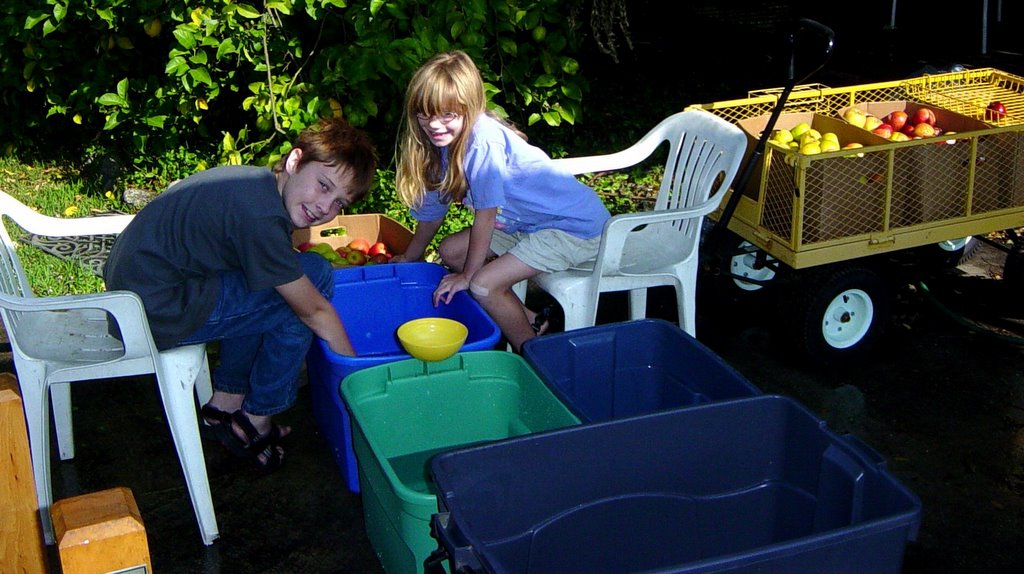
The press is assembled; Leslie is in the house sterilizing bottles, the kids are washing and culling apples, and soon it will be cider.

The washing process gets all the stems and dirt and leaves, but also any agriculture residues. Fortunately, about a third of our apples are organic, so that helps. And these came straight from the orchard, before they could be sprayed in waxes or oils to make them look pretty, so we don't have to wash quite so hard to get that off. But they are seconds, and so we have to cull the few with rotten spots, and those with open holes, or cuts.

The cuts can (and often do) breed mold and bacteria, but these can often be removed. Similarly, a small hole on the outside generally means that a critter has moved in, and spoiled some or all of the apple. Out of four bushels, we had about a half bushel of "suspect" apples, and out of that wound up with about two gallons of rotten fruit and cut off bits. Not bad at all.

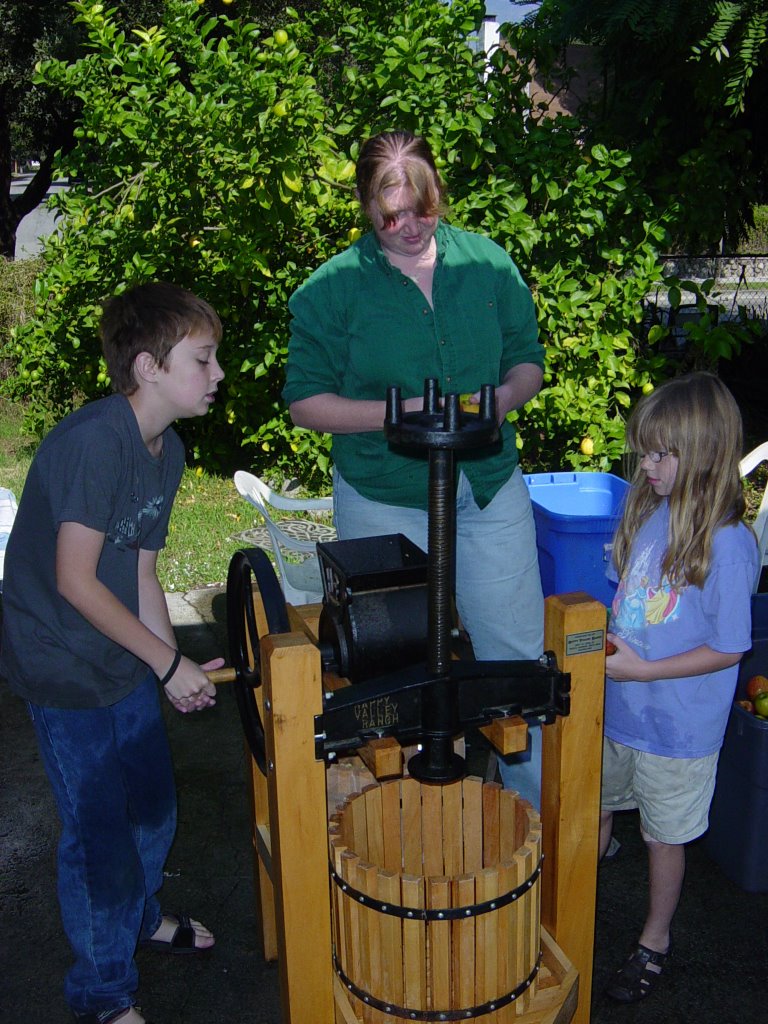
The big kids took turns feeding apples into the grinder and turning the grinder crank. The crank can be hard work, although the fly-wheel helps keep it rolling. Every so often an apple would get jammed in just right or one sibling would joyfully feed too many apples to crank, bringing the cranker to a stand still. Eventually it came down to the adults to finish the cranking.

Sometimes, the apple-feeder would forget to feed the apples, watching, in fascination, as the "apple eater" grinder chopped away at a whole apple. It only takes one reminder each year that the apple-eater eats fingers too. (Wicked grin.) Watching a very solid apple slowly vanish as it is turned to mush is a good reminder too.

Once the ground apples were ground, the kids (and then the adults) took turns turning the screw that pressed the cider.

This year, we bottled gallons -- in part to deliver several to my mom, and in part because we only did four bushels. The bottling process involves swapping out the metal pan under the press for an empty one, and walking the cider, carefully, over to the funnel in the gallon jug. We do pour the cider through sieve to trap large apple bits, and any other debris that might have gotten into the catch-bowl. But 99.9% of the suspended apple solids go right into the bottle.

In years past we have pressed a 50-50 of Granny Smith and Red Delicious. The cider was darker than even unfiltered store bought, and pretty darn sweat.

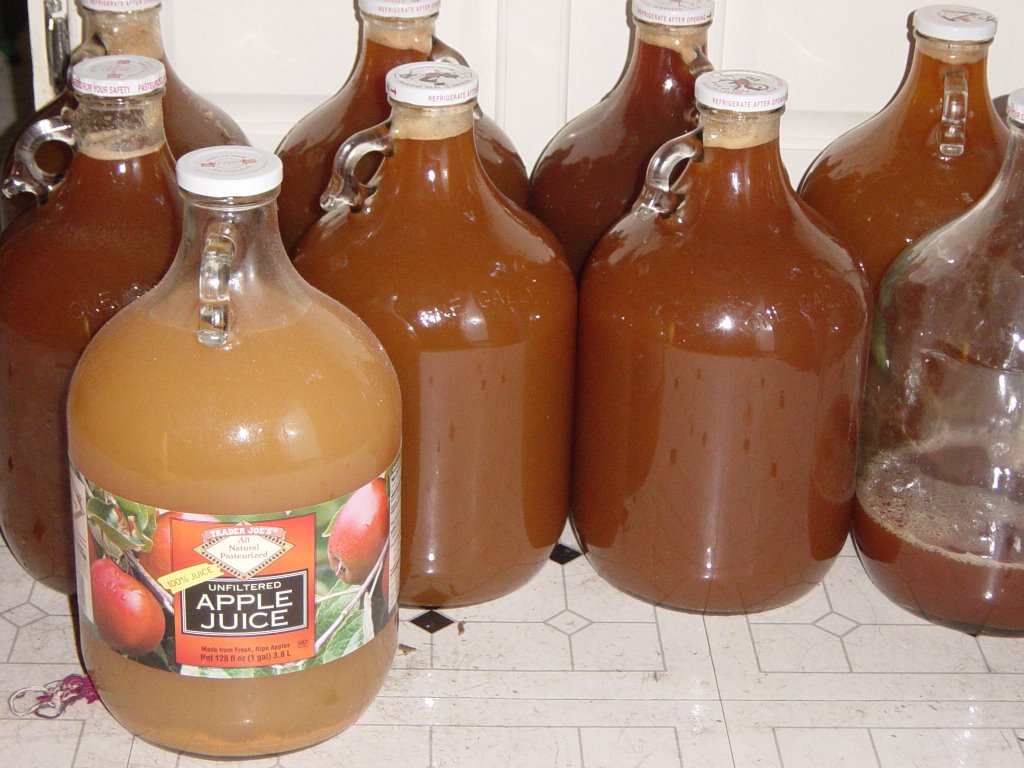
This year's cider came out of the press even darker, a rich cinnamon brown. Really dark. To the degree thatin a certain light it looked like a jug of coffee. The flash in these photos lightened it up a great deal, but here it is compared to Trader Joe's unfiltered apple juice. And most people consider that a little dark!

Out of four bushels we pressed about 8 gallons, drank most of a gallon during pressing and gave four to my mom. Not a bad yield, but not as high as we sometimes get.

Still, we have cider!

Friday, November 11, 2005

Woo Hoo! Peak Experience

Today we peaked!

As the winter sun transits lower in the sky and hits our solar cells close to the perfect angle, we produce 100% of our cells rated capacity. Or rather, in this case we produced more than that, because the sun angle is right, the sun is bright (between clouds) and the temperature is cool.

Not only did we hit more than the 2403 Watts nominal at which our system is rated, we peaked past the 2500 Watts for which the inverter is rated. No worries, as the peaked out production is transitory, but indicates that we are getting the most out of the system possible.

Last spring, from mid-February to late March, a bright sunny, cool day would produce the same result. On the brightest days over the summer we only got 80% or less rated capacity, because he sun angle was much higher and the heat of the summer reduced production.

So: With luck it will turn out that we have from early November to late March with peak production; we have covered about 90% of our usage so far (since April 7, our contract date). We were at 110% plus during the spring, but are currently about one months worth of electricity "behind" due to slightly lower production over the summer. At this rate we should be able to hit 100% by April 7, provided there are not too many cloudy or rainy days.

Woo Hoo!

Thursday, November 10, 2005

Donner und Kopfsalat

Thunderstorms, flash floods, torrential rains and mudslides all predicted by forecasters finally arrived, but disguised as their mild-mannered alter ego: Light drizzle and the odd brief cloudburst. So much for the science of weather forecasting.

The broccoli is growing great guns, and should need thinning by Sunday. Several of the salad greens, now, are up, with three tiny romaine sprouts and a bunch of other miscellaneous peeking out. No corn salad (maché) up yet, which gives me pause. Still, I tend to plant too deep, and the other things are up just fine.

Almost to confirm my unfortunate sowing skills, two new garlic bulbs have sprouted among all the 6-8 inch plants; it apparently took awhile for them to grow enough to get past the depth of the soil (sigh).

Cider Press Repair

Took apart the cider press yesterday, to install a new pressing tray. Found a couple of small unpleasant surprises, but nothing too major.

First, when we purchased the press I built then sealed it with “e-z-do” a food-safe butcher-block sealant. As a result, I did not get sealant on the parts where wood touched wood. Under the pressing tray, one section had a little mildew; the other had a small wood eating creature making its home.

Cleaning up these two bothers delayed re-installation of the drip tray and our cider pressing by another day

We will press cider in the morning, as it is a school holiday and everyone will be home. Might even have a little fire in the outdoor fireplace to take the morning chill off. If I can find enough scrap wood. (We haven’t either picked up or purchased significant firewood this year. Just plain busy, what with the new baby, and not a lot of spare change for a cord of wood from the local supplier.)

Share the Road

Just noticed today that Share the Road signs have gone up all along Mountain as promised by the city. We really needed them on this little strip of road, as it is a major linkage between two bike paths. And the local folks did not seem inclined to follow the law and allow bikes the use of the roadway. This should help some.

Wednesday, November 09, 2005

Rain, no rain; or was it rain again?

Rain has begun to fall in the last few minutes; the weather people have been beside themselves with indecision, even at one point saying that two different computer models came up with very different forcasts. As it was the rain was supposed to start yesterday evening.

Guess I'll just stay here, warm in the house.

Saturday, November 05, 2005

Sippin' Cider

Spirited email exchange with my mom, and some apple rancher's in Oak Glen. Her Aunt and Uncle used to own an apple ranch, and when she was a little girl she lived there awhile, her mom and dad working on the ranch.

She tells some great stories about the one-room school house she attended (I have seen it, but I remembered that it looked a lot like the classic little red school house in all the free Word graphics, -- only weathered gray. Turns out it was gray because it was built of local river rock. Hmmpf. ) The old school house has been made into a museum.) And of course the story of riding in an apple crate on the rollers in the packing shed is a classic, which I must have tried a dozen non-farm ways to duplicate.

A one-time family cider pressing when I was young, just after her Aunt sold the place, made a deep impression on me. I have eight apple trees on my city lot here in Pasadena, and after decades of lusting after it, a few years ago bought myself a double-tub cider press.

We don't produce enough apples for cider, we got about a bushel this year, which is great considering four of the trees were just planted this year after several years elsewhere stunted in pots (not my fault). They only produced a half dozen cider quality apples between 'em. And one of the remaining four trees either has bad grafts that have kept it stunted, or is affected by the oak tree litter from the street tree near it, and any apples that do grow on it are swiped by passers by while green anyway, 'cause the poor little tree is the one next to the street.

So we decided to go up to Oak Glen to get some apples, go crazy pressing cider, and put down five gallons for hard cider if we get that much, or just drink it ourselves for months. (For larger views, click on any picture.)

There is nothing more satisfying than raw, hand pressed cider. Whether caught in a cup straight from the prss, or mellowed a few weeks later. Mmmmmm.

Apple Picken'

The apples in our yard start and finish early, and we don't have enough trees for a good cider making quantity. So, and to get special apples for my mom, we made the trek to Oak Glen, California. An online acquaintance of nearly 15 years now has a ranch up there, and although the "u-pick" apples are all-picked for now, there are still apples to be had.

We tried to make arrangements to meet at the back of the Riley ranch to glean the last of the crop and pick up several bushels of windfalls -- generally sound apples that have dropped off the tree. Alas, we came up the dusty back road, as did a van full of another family, but no farmer. The pickers in the field didn't know about the arrangements we'd made, so we drove back down the back road, and came around into the main part of Oak Glen.

Apples can be had several ways, here. In small fractional bushels, that wind up being $30-40 a bushel -- considerably more than the retail cost at our local produce market. Or you can go to a "u-pick" orchard, where, as the name implies, you pick the apples off the trees yourself. Unfortunately, pretty much all the "u-pick" sites were "u-picked" out. So we resorted to the third way, which was stopping and asking the price for several bushels of cider apples, what some people called seconds.

Now, cider can be pressed from ugly apples just fine. Even ones with a little rot or spot can be cut apart and the good part pressed. Hand or eating or table apples (depending on who's namin' them) are essentially perfect, and often sorted by size, so they cost a bit more.

But by asking for cider apples or seconds, we got the ugly apples at a one-half to one-quarter of the price of the pretty ones. So, we now have four bushels of apples sitting in the back yard, waiting for all the kids to be home to press cider Tuesday night.

Meanwhile, Back at the Apple Ranch

We drove the Oak Glen loop, from Riley's to Law's, with stops along the way at the Los Rios Rancho (now called Riley's Los Rios Rancho, as the Riley family has leased the place. All the apple production on the Rios Ranch is organic, which is good news. We stopped too at Snow-Line, which is where we got our good deal on seconds.

Our bushels contain local organic Fuji's, Granny Smith, Pink Lady, Rome and Jonathan. Those happen to be the varieties that "the ladies" were sorting that day, and so a box of mixed seconds was available.

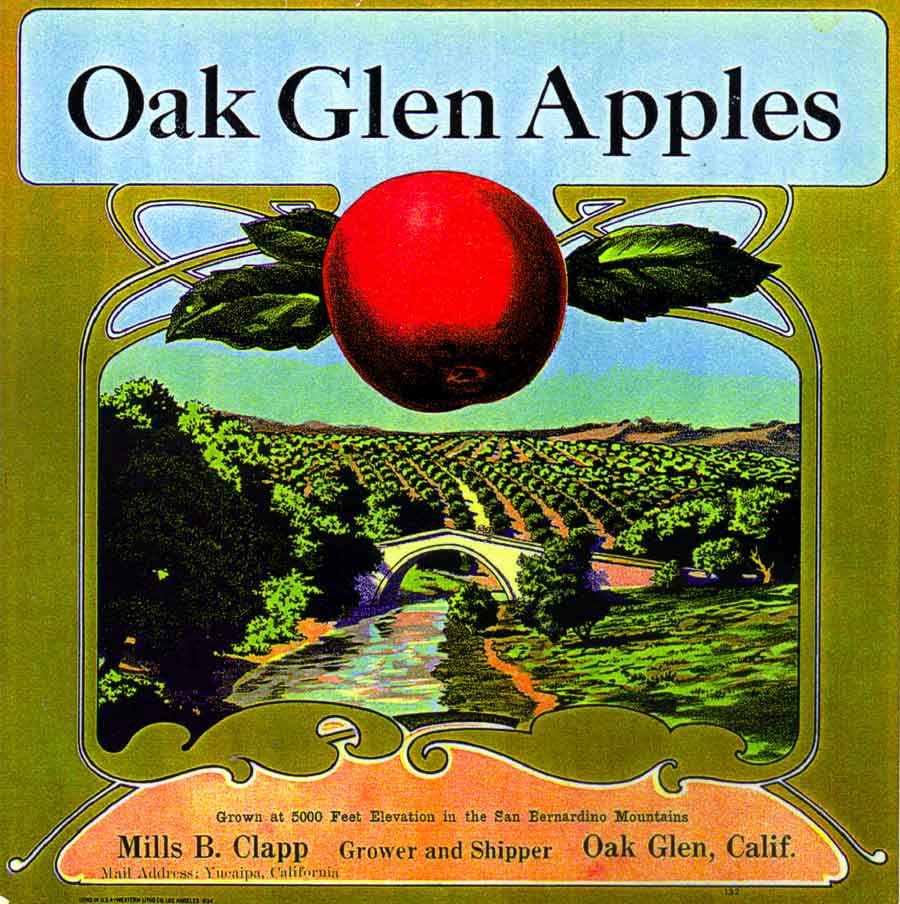
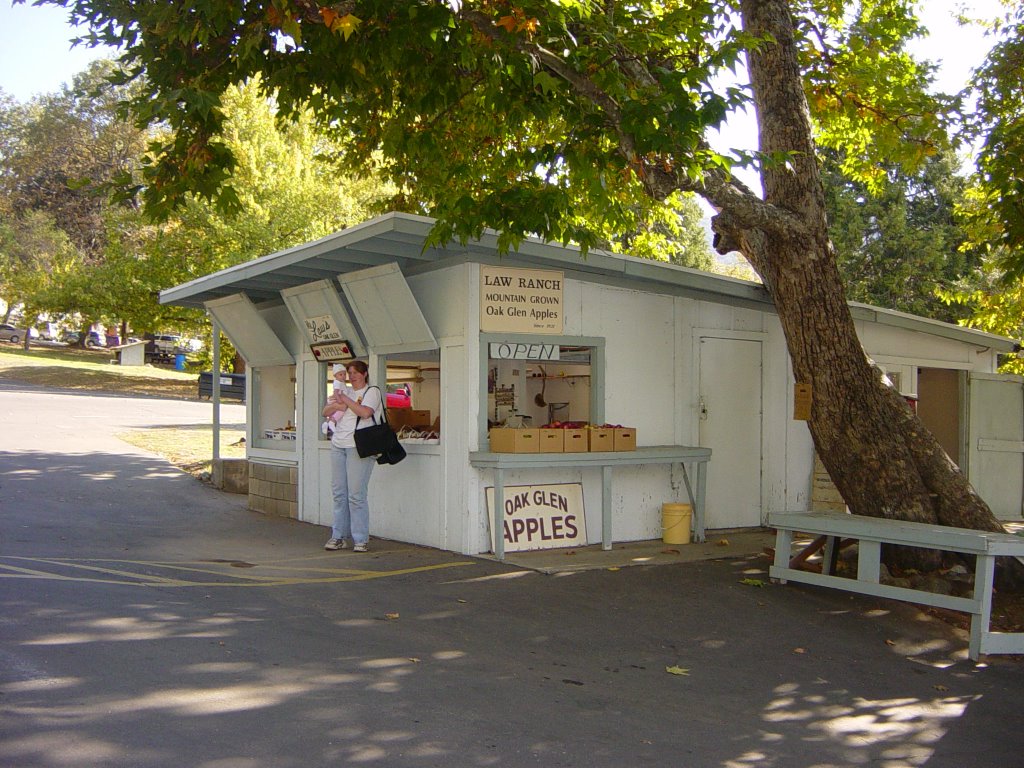
We stopped in to have lunch at Law's Coffee Shop, and to my great wonderment, an old packing label was up on the wall from the ranch run by my Great-Grand Uncle Mills B. Clapp, and his wife, Lila McConnell Clapp. I asked if anyone knew where the old Clapp ranch used to be, and the ladies at the counter ran back and dragged a gray-haired but not old looking fellow in an apron covered in cooking debris. Mustard was prominently visible on the front.

Turns out, this ol' boy is Kent Colby, step-son of the founder of the ranch, and current proprietor of the coffee shop. The shop was started in about 1953, while my Gr-Gr-Aunt and Uncle were still operating. Kent, and his wife, took over the coffee shop in about 1974, and he's been at it ever since. Seem that he is the local historian too.

Kent said the ol' Clapp place was just off the Harris road, the first road on the right past the bend. The old Clapp house could be seen in the woods, he said. The property had been sold a couple of times since Lila Clapp sold it in the late 1960s or so.

Now the last time I recall going to Law's had to have been 30 or more years ago -- probably about the time Kent was taking over. Great Aunt Lila used to come up pretty much weekly for a few years. She had no children, and her only sister had one surviving son, my grandfather. He used to drive Lila up to the Glen from Riverside, in her '51 Cadillac, for lunch at Law's every week.

"Oh yes, I remember Mrs. Clapp," Kent told me. "Used to come up here every week for awhile for lunch with her chauffeur or something." Ooooboy. Granddad would have laughed to hear himself described as the chauffeur. 'Course that's what he was, for the day. But still, its quite an image of ancient Mrs. Clapp, dressed to the nines, driven up by my 6'4" construction-worker-physique grandfather.

So we chatted awhile, and he didn't have a firm grip on my mother "little Lila", but had a sort of vague recollection. Frankly, I couldn't tell if he was being polite or if he was a heck of a lot older than he looked, and he might actually have had a faint recollection of my mom's family. Hardly matters; we remember Law's, and its right where we left it.

The apple pie was of course quite tasty -- although there was a moment of surprise to be gotten over when it dawned on us that this was fresh apple pie, from apples picked a 100 yards up the hill. There was no corn-syrup sugar goo -- just sweet, good apples and a flaky crust.

Having taken Hannah Lila up to see the apple groves where Grandma Lila and Great-Great Aunt Lila pressed cider, I think we'll have to go back to Law's in the future, for no particular reason.

Meantime, I need to finish getting the cider press oiled up and cleaned off, replace the drip pan that was shipped to me in February, and get ready to squeeze off 10 or 12 gallons of cider!

Thursday, November 03, 2005

Slipping Into Fall

Cool, damp morning today; a hint of winter moisture in the air, after two or three days of 90F heat. Because it gets cool at night our 102-year-old house never got hotter than 74 for most of the day, and I was able to leave the air conditioner off. (Until this summer, we didn't have an air conditioner; between the hotter falls we've been having and the new baby, we thought it was time.)

Lettuce has sprouted! Two very tiny little plants -- and only two -- have sprouted in the horse trough salad garden. That's a 200% increase over the last crop, where none of the seeds sprouted before the heat of the composting topsoil and ants got 'em. There may be hope yet for the winter salad garden after all.

Broccoli is up two, much better growth, lots of plants, due to be thinned soon. Or rather moved. Some sections of the broccoli patch are bare, others have crammed in seedlings. (Shrugs) The seed was pretty evenly sown, and there is little difference that I can detect in the Broccoli patch sections that sprouted and those that didn't, but there you have it. So the crowed guys will get thinned, and if they survive it, transplanted to the bare spots.

We made a trip to Oak Glen yesterday, about which I will do a separate post; came back with four large bushels of apples for cider, though. Now I am scurrying to clean out the patio and clean up the cider press. We will probably press early next week, when Spencer is home.

Spencer is off at an Outdoor Ed camp, part of his 5th Grade science unit. Hope he enjoys it; I didn't have the heart to tell him that a lot of what they are going to talk about is eco-systems, composting, watersheds, recycling, map reading, tracking -- all those things we do around here or I am forever telling him about. I expect that the activities will be fun, however, and I know that at least some of it will seem new to 'em 'cause it won't be preached by Dad. (grin).